
Quick answer: To become a blockchain developer in India, learn programming basics (JavaScript or Python), then blockchain fundamentals, then Solidity and smart contracts. Deploy projects on a testnet, learn smart contract security, build 3 portfolio projects on GitHub, and apply through internships, hackathons and grants. Most beginners need about 6 months of steady part-time practice.
Key takeaways:
- You do not need a computer science degree. BBA, BCA, B.Tech and self-taught learners all enter this field.
- Solidity, smart contract security and a public GitHub portfolio matter more than certificates alone.
- A deployed project on a testnet is stronger proof than a list of courses.
- Plan for roughly 6 months at 10 to 15 hours a week.
Blockchain hiring in India is quiet compared with web development, but it is real. Startups in Bengaluru, Pune and Hyderabad, global protocols that hire remotely, and hackathons all look for people who can ship working smart contracts. This roadmap shows what to learn, in what order, and how to prove it.
What does a blockchain developer do?
A blockchain developer designs, writes and tests the software that runs on distributed ledgers. In practice, most work is writing smart contracts, which are programs that run on a blockchain, and connecting them to web or mobile apps.
Typical tasks include writing and testing Solidity contracts, deploying them to a network, building a front end that talks to them, and fixing security flaws before launch.
Which blockchain developer role fits you?
| Role | What you build | Core skills |
|---|---|---|
| Smart contract developer | Contracts for tokens, DeFi, NFTs, DAOs | Solidity, testing, security basics |
| dApp / full-stack Web3 developer | Web apps that connect to contracts | JavaScript or TypeScript, React, ethers.js |
| Protocol / core developer | The blockchain network itself | Go, Rust or C++, consensus, networking |
| Smart contract auditor | Reviews code for vulnerabilities | Solidity depth, attack patterns, audit tools |
Most beginners start as smart contract or dApp developers. Core and auditor roles usually come after a year or more of experience.
Do you need a degree or coding experience to start?
No. Employers and hackathon judges look at what you have built. Many learners in Pune, Mumbai and Delhi NCR come from BBA, BCA, commerce and non-IT backgrounds and move in through self-study and structured programs.
Some programming helps. If you have none, spend the first 4 to 6 weeks on JavaScript or Python basics before touching Solidity. Beginner programs such as MasterStroke Academy start from internet and cryptography fundamentals for this reason.
The 10-step roadmap to become a blockchain developer in India
Step 1: Learn how the internet and cryptography work
- Understand hashing, public and private keys, and digital signatures.
- Know what a block, a transaction and a wallet actually are.
- Time: 1 to 2 weeks.
Use the glossary to keep terms straight as you go.
Step 2: Build programming basics
- Pick JavaScript or TypeScript (best for dApps) or Python.
- Learn variables, functions, objects, arrays and async code.
- Learn Git and GitHub from day one.
- Time: 4 to 6 weeks if you are new to coding.
Step 3: Understand how blockchains work
- Study consensus (Proof of Work, Proof of Stake, Proof of Staked Authority), nodes and validators, gas and finality.
- Learn what makes a chain EVM-compatible: the Ethereum Virtual Machine lets the same Solidity code run on many networks.
- Time: 2 weeks.
See how a real network is designed on MST Blockchain, an EVM-compatible Layer 1, and read about its protocol layer.
Step 4: Learn Solidity and smart contracts
- Start with Remix IDE in your browser. No local setup is needed.
- Learn data types, mappings, structs, events, modifiers and inheritance.
- Write a simple storage contract, then a voting contract.
- Time: 4 to 6 weeks.
Step 5: Set up wallets and deploy to a testnet
- Install a wallet such as MetaMask, then get test tokens from a faucet.
- Deploy your own contract and read the transaction on a block explorer.
- Time: 1 week.
Use a non-custodial wallet so you hold your own keys. BridgeKey is the multi-chain wallet for MST Blockchain, and Top 10 Best Crypto Wallets? explains the idea in plain language. You can practise on the MST testnet explorer and view activity on the MST mainnet explorer.
Step 6: Learn token standards and common patterns
- ERC-20 (fungible tokens), ERC-721 (NFTs) and ERC-1155.
- Use audited OpenZeppelin libraries instead of writing everything from scratch.
- Time: 2 to 3 weeks.
Step 7: Learn smart contract security
- Study reentrancy, integer errors, access control mistakes and front-running.
- Run static analysis tools such as Slither and read public audit reports.
- Time: 3 to 4 weeks. Do not skip this: deployed contracts are hard to change.
- Real-world lesson: the 2016 DAO attack used a reentrancy flaw and led to a split in Ethereum. Every Solidity learner should read how it worked.
Keep your own keys safe while you test: learn the difference between online and offline storage in Hot Wallet vs Cold Wallet and the BridgeKey security page.
Step 8: Add a front end
- Connect your contract to a React app using ethers.js or web3.js.
- Handle wallet connection, transaction status and errors.
- Time: 3 to 4 weeks.
Step 9: Build and publish 3 portfolio projects
- Examples: a token, a voting or DAO app, a certificate or credential system.
- Write a clear README, add tests and keep commits regular.
- Time: 4 to 6 weeks.
Step 10: Apply, compete and keep learning
- Join hackathons, open-source repositories and local meetups.
- Apply for internships and ecosystem grants, such as the MST Blockchain grants.
- Learn the network side too: the fractional validator program shows how validators work, and the MST community portal connects you with other builders.
- Time: ongoing.
What does your first week of learning look like?
A concrete first week removes the biggest barrier, which is not knowing where to start.
- Day 1: create a GitHub account and read what a block, hash and transaction are.
- Day 2: install a wallet and open a block explorer. Look up a real transaction and identify the sender, receiver and fee.
- Day 3: open Remix IDE and compile the default storage contract.
- Day 4: deploy it to a testnet and call its functions.
- Day 5: change the contract so it stores a name and a number. Break it on purpose and read the error.
- Day 6: write down every term you did not understand and check it in the glossary.
- Day 7: deploy a second contract and share the transaction link in a community or with a mentor.
Illustrative scenario: a BBA graduate in Pune studying evenings and weekends spends month one on JavaScript, month two on Solidity in Remix and month three on a token and a voting contract. By month five she has three repositories and one testnet dApp. The route is realistic, but it depends on steady weekly practice. This is an example, not a guarantee.
How long does it take to become a blockchain developer?
A beginner studying 10 to 15 hours a week usually needs about 6 months to become job-ready for an entry-level or internship role. People who already code can often do it in 3 to 4 months.
| Month | Focus | Output |
|---|---|---|
| Month 1 | Fundamentals and programming basics | Git account, small JavaScript or Python scripts |
| Month 2 | Blockchain concepts and Solidity basics | First contracts in Remix |
| Month 3 | Testnet deployment, token standards | ERC-20 token live on a testnet |
| Month 4 | Security and testing | Tested contracts, audit checklist |
| Month 5 | Front end and dApp | Working dApp with wallet connect |
| Month 6 | Portfolio and applications | 3 projects, resume, first applications |
Which tools and languages do you need?
| Category | Tools | Use |
|---|---|---|
| Language | Solidity, JavaScript or TypeScript | Contracts and front ends |
| Editor and IDE | Remix IDE, VS Code | Writing and testing code |
| Frameworks | Hardhat, Foundry | Compile, test and deploy |
| Libraries | OpenZeppelin, ethers.js | Secure contracts and wallet connection |
| Wallet | MetaMask, BridgeKey | Signing test transactions |
| Security | Slither, audit reports | Finding vulnerabilities |
Which projects should go in your portfolio?
- A token with tests: an ERC-20 with minting limits and a test suite.
- A voting or DAO app: shows access control and events.
- A credential or certificate system: a good fit for India, where certificate fraud is a known problem and verification matters.
- A land-record or supply-chain tracker: shows you can model real-world data on a chain.
For each project, publish the code, a short write-up of what it does and a link to the testnet transaction. Recruiters often skim GitHub in under two minutes, so keep the README clear.
How do you get your first blockchain opportunity in India?
- Internships: early-stage startups and ecosystem programs often take juniors with solid GitHub projects. Ask programs like MasterStroke Academy about internship pathways.
- Hackathons: build in 24 to 48 hours with a team. Winning is a bonus; the shipped project is what counts.
- Grants: some networks fund early builders. MST Blockchain grants list three tiers, from up to $1,000 for early prototypes to up to $50,000 for production-ready apps.
- Freelance and open source: small contract-review or bug-fix tasks build a public record.
- Community: attend MST college events and local meetups to meet builders.
What works for learners in Pune, Bengaluru, Hyderabad, Mumbai and Delhi NCR?
Bengaluru and Hyderabad have the largest number of Web3 startups and meetups. Pune has a strong student and IT-services base, with learners in Baner, Hinjewadi, Kothrud and Pimpri-Chinchwad often balancing college or a day job. Mumbai leans toward finance and tokenization use cases. Delhi NCR has active hackathon and community groups.
You do not need to live in any of these cities. Online, self-paced learning plus occasional in-person meetups covers most of what you need. Evening and weekend study suits working professionals and final-year students.
What questions come up in blockchain developer interviews?
- What is the difference between a hash and a digital signature?
- What is gas, and how do you reduce it in a contract?
- What is reentrancy, and how do you prevent it?
- What is the difference between `call`, `delegatecall` and `transfer`?
- Explain ERC-20 vs ERC-721.
- Why is a contract hard to change after deployment, and what are upgrade patterns?
- Walk me through your best project and what you would change.
Practise answering these out loud, and keep a short project walkthrough ready. It is the question that decides most junior interviews.
Why do EVM skills transfer between blockchains?
The Ethereum Virtual Machine (EVM) is the runtime that executes Solidity contracts. Many networks, including MST Blockchain, are EVM-compatible, so the code, tools and wallets you learn once work across them. That makes EVM and Solidity a safe first investment for a beginner in India or anywhere else.
What mistakes do Indian beginners make?
- Jumping to Solidity before learning basic programming
- Watching tutorials without deploying anything
- Skipping security and testing
- Chasing token prices instead of building
- Collecting certificates with no projects
- Paying for guaranteed-job promises
How can MasterStroke Academy help you become a blockchain developer?
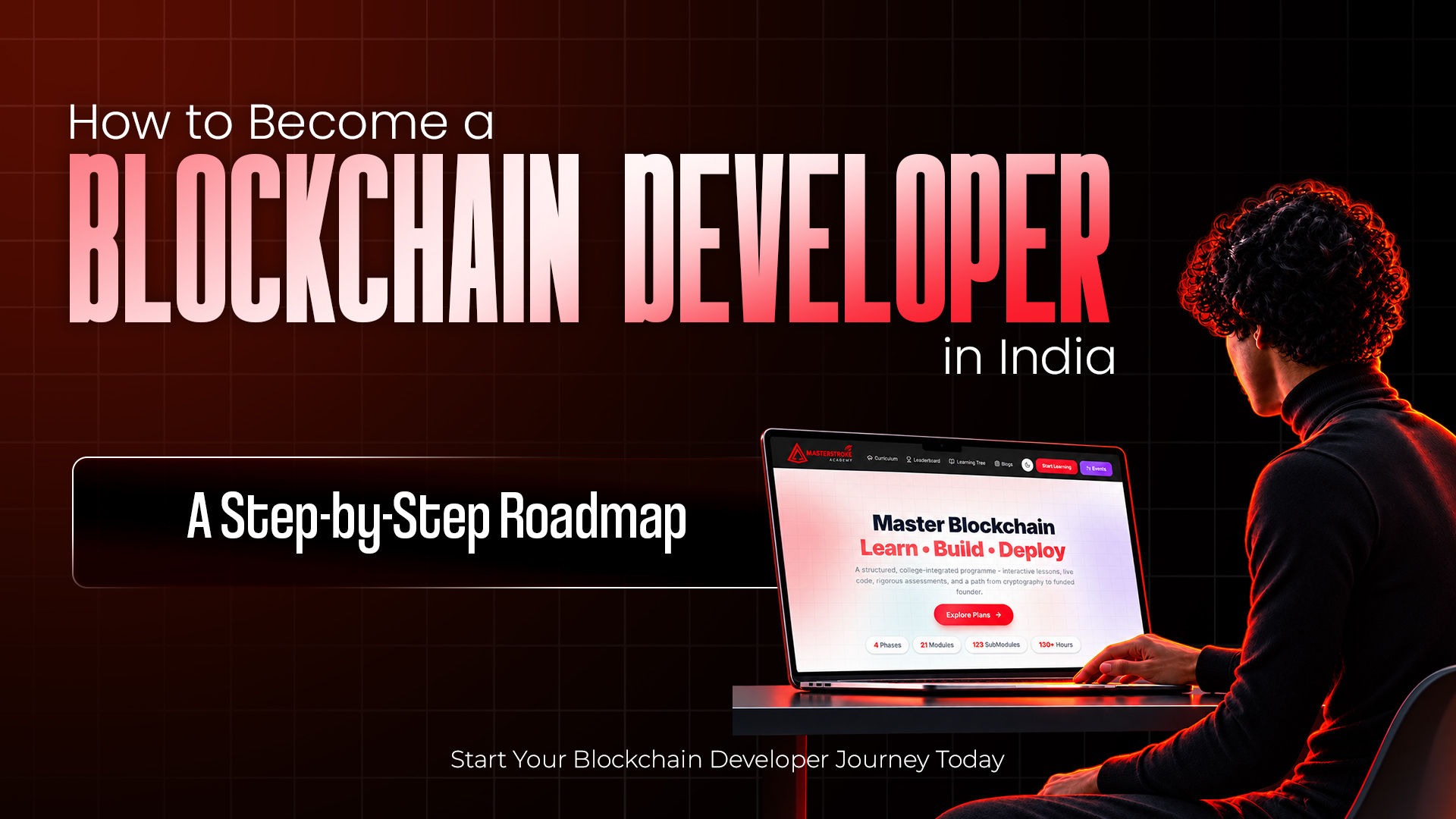
MasterStroke Academy follows the same order as this roadmap. It has 4 phases, 21 modules, 123 submodules and over 130 hours of content, and starts with internet and cryptography fundamentals, so no coding background is required.
- Live coding: Solidity in a browser IDE, executed on MST Blockchain, an EVM-compatible Layer 1, so your skills carry over to Ethereum-style networks.
- Verifiable certificate: recorded on-chain, so employers can check it.
- Graded progress: 70% or more on each submodule to unlock the next; coding and projects count towards marks.
- Free to start: register at no cost, then choose a Fellowship plan for full access.
- Funding route: top capstones can pitch for ecosystem grants of up to $50,000.
- Support: Monday to Saturday, 10 am to 6 pm IST, with a published refund policy.
Honest limits: MasterStroke is newer than long-established institutes and is self-paced, so you need discipline. Fellowship prices are not listed on the course page. Compare options first with the comparison page and read the FAQ.
Start your blockchain developer journey today
Do not wait for the perfect plan. Write your first contract this week.
- Start free: create your account and begin Phase 1.
- See the full path: curriculum overview.
- Build on a real network: MST Blockchain and the testnet.
- Need guidance? Talk to the MasterStroke team, Monday to Saturday, 10 am to 6 pm IST.
FAQs
How do I become a blockchain developer in India with no experience?
Start with programming basics in JavaScript or Python, then learn blockchain fundamentals, Solidity and smart contract security. Deploy 3 projects to a testnet and publish them on GitHub. Most beginners need about 6 months.
Which programming language should I learn first for blockchain?
Learn JavaScript or Python first, then Solidity. Solidity is the main language for EVM-compatible blockchains, and JavaScript is used to build the front end.
Can a non-IT or BBA graduate become a blockchain developer?
Yes. Employers check your projects and code, not your degree. Non-IT learners should allow extra time for programming basics.
How long does it take to become a blockchain developer?
About 6 months at 10 to 15 hours a week for most beginners, and 3 to 4 months if you already code.
Do I need a blockchain certificate to get a job?
No certificate is required. A verifiable certificate helps, but a GitHub portfolio with deployed projects carries more weight.
What is the difference between a blockchain developer and a smart contract developer?
A smart contract developer writes the on-chain programs. A blockchain developer is a wider term that can also include dApp, protocol and core network work.
Is blockchain development a good career in India?
It is a growing niche with opportunities in startups, remote protocol teams and hackathons, though fewer roles exist than in general web development. Strong skills and a visible portfolio make the difference.
Where can I learn blockchain development in Pune?
You can learn online from anywhere and attend local meetups in Pune. Choose a program with live coding, a verifiable certificate and a clear refund policy, such as MasterStroke Academy.
How can I practise smart contracts for free?
Use Remix IDE in your browser, a free wallet and a testnet faucet. You can deploy and inspect contracts on the MST testnet explorer at no cost.